Tag Archive for: bourbon

Long Road Distillers

In Part 4 of our “What is Bourbon” series, we dig into the final requirement for a spirit to be considered bourbon – the aging process – and how that can impact not only how a bourbon tastes, but also how it is labeled.

First, as a bit of a refresher, recall that the legal definition of bourbon whisky, according to the TTB, is:

Whisky produced in the U.S. at not exceeding 80% alcohol by volume (160 proof) from a fermented mash of not less than 51 percent corn and stored at not more than 62.5% alcohol by volume (125 proof) in charred new oak containers.


For those new to whisk(e)y or unfamiliar with the process, it’s often a surprise that it all comes off the still clear. It’s only through the aging process in a barrel that the spirit gains it’s familiar caramel or amber colors. The barrel also contributes many of the flavors and aromas we’ve come to expect from our favorite whiskies.

This portion of the definition really covers two details: the storage in a barrel and a limit on the alcohol by volume during said storage.

Before we jump into both details, it’s fair to ask: why is whisky barrel aged at all? The answer is a practical one. Back when whisky was first distilled, the best way to store and ship the finished product was in wooden casks. As we touched on in Part 1, Bourbon whisky, in particular, was shipped down the Ohio River to New Orleans in wooden barrels marked for Bourbon Street. Most spirits of the day would have been stored in barrels, but only over time did people realize the benefits of barrel aging.

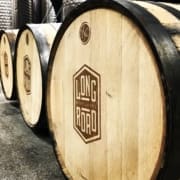
American Oak must be used in the making of bourbon barrels. Oak has a unique physical and chemical nature that allows it to be manipulated into a barrel, but also has a tight enough grain that it will not leak while still allowing oxygen to move in and out of the spirit.

Beyond these physical characteristics, though, the oak offers three effects on an aging spirit:

  1. It adds to the taste and aroma of the spirit, such as vanillins, lactones, and wood sugars
  2. It acts as a filter, removing undesirable elements from the spirit such as sulfur compounds
  3. It converts unpleasant compounds, such as acetic acid, into more organoleptically desirable elements, like fruity esters


Essentially, the chemical breakdown of the wood sugars contributes flavors that are desirable, while the wood and char combine to contribute spice and toast characteristics.

The second half of this section relates to the proof/abv during the aging process. The Standards of Identity from the TTB requires that the spirit enter the barrel at no higher than 125 proof or 62.5% alcohol by volume. One reason for this is tradition. Early distillery equipment likely didn’t distill the spirit to a very high proof.

The second reason to maintain an upper limit on proof is to keep the level of extraction from getting too out of hand. If you’ve tasted a lot of whiskies, chances are that you’ve run across a whisky that was “over-extracted”. By this, we mean too oaky and on the verge of tasting like a stale cigarette. The higher the proof of the spirit in the barrel, the more quickly it will pull flavors from the barrel and the less time it will have to mellow out and interact with the char, providing the filtering effect.

The length of time the spirits rests in a barrel impacts the final characteristics, too. In general, the longer a spirits rests, the more mellow it will become. Nearly all whisky that is aged less than two years requires a statement of age on the label. This gets into some of the different indicators you can look for on a bottle of bourbon. For example:

Straight Bourbon – must be aged a minimum of two years.

Bottled in Bond Bourbon – must be aged a minimum of four years, distilled in a single season, and bottled at 100 proof.

Finally, the size of the barrel has an impact on the aging process, flavors, aromas and finish of a whisky as well. The smaller the barrel, the greater the surface area-to-volume ratio there is between the wood barrel and the resting whisky. In turn, the smaller the barrel, the faster the aging process and the more flavor will be pulled from the wood. Many start-up distilleries will use 5, 10, or 15 gallon barrels to age their first-release whiskies more quickly, versus opting for a traditional 53 gallon barrel. While this does speed up the process, a distiller also runs the risk of overextraction of tannins, oak, and undesirable flavors, without allowing time for mellowing.

For our Straight Bourbon Whisky, we have used 53 gallon Independent Stave Company (ISC) barrels with a #3 (medium) char and light toast. The whisky was aged for over 2 years, with other barrels still hanging out in the warehouse for a later release.

We’re excited to share this special release with you beginning at 4pm on Tuesday, April 10. Stay tuned for more information about finding it at bars, restaurants and retailers beginning in May!
Long Road Distillers

Today, we wade into a lesser-known part of the definition of Bourbon, which also means it’s a bit less controversial.

First, as a bit of a refresher, recall that the legal definition of bourbon whisky, according to the TTB, is:

Whisky produced in the U.S. at not exceeding 80% alcohol by volume (160 proof) from a fermented mash of not less than 51 percent corn and stored at not more than 62.5% alcohol by volume (125 proof) in charred new oak containers.


The phrase “Alcohol by Volume” (ABV), when associated with a percentage, is quite literally what it sounds like: the measure of the content of ethanol (alcohol) in an alcoholic beverage by volume. It is required by the Code of Federal Regulations for distilled spirits labels to include the ABV on the front of the bottle.

The term “proof”, while not required on spirits labels, is often included, particularly when it comes to whisk(e)y. The history of the term dates back to the 16th century and involves gun powder, taxes, and rum – a fun history indeed, but something for another blog post! The easiest way to understand proof in the United States is simply twice the ABV of an alcoholic beverage. So, a 100 proof whisky has an ABV of 50%.

This part of the definition has to do with the ABV/proof of the spirit as it comes off the still. Distillers are able to change the conditions in the still to control the ABV/proof during distillation, including the amount of heat applied to the mash, the amount of plates the alcohol vapor comes in contact with, or the amount of cooling water in the condensers that will cause reflux and re-distillation, just to name a few. The mandate here is to keep the spirit coming off of the still at or below 80% alcohol or 160 proof.

The question one could ask is: why limit this?

The answer: Taste and aroma.

The process of distillation is really a process of volume loss. To offer a rough example, we take 500 gallons of 6% mash/wash, distill it up to 45% ABV and between the heads cut, tails cut, and what’s left behind in the still, we lose most of our volume, yielding approximately 80 gallons of spirit. We’ll then distill that a second time to a higher ABV and lose even more volume. Essentially, we’re pulling the alcohol out into higher and higher concentrations, leaving behind water, grain, and yeast.

In this process, we’re not only leaving behind water, but flavor compounds, congeners, and impurities.

By definition, vodka must be distilled up to or exceeding 190 proof or 95% alcohol. The process of distilling something to 190 proof will theoretically leave it “odorless and tasteless”. The alcohol was concentrated and water and compounds were left out.

So, by requiring Bourbon to be distilled at or below 80% alcohol or 160 proof, more flavor is maintained. Now, we can’t say that maintaining flavor is the reason the Federal Government mandated this limit, but what they were trying to do was create a recognizable, familiar type and class so consumers could understand what they’re getting in a bottle. By mandating a maximum proof at distillation, the hope is that bourbon whisky produced in this manner will then have the “taste, aroma and characteristics generally attributed to” this type of whisky.

If you want to experience this phenomenon in person, stop in to the distillery and taste the difference between our unaged Corn Whisky, distilled to only 152 proof, and our vodka, distilled to 191 proof. While the mash bills (recipes) are different, you’ll still begin to understand the difference “proof at distillation” has on a spirit. The Corn Whisky has loads of flavor, even a bit of bite, while the Vodka flavors are much more soft and subtle.

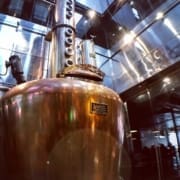
At Long Road, our experienced team of distillers takes great care in crafting a unique product with robust flavors in a consistent manner. We’re proud of the fact that we worked with Vendome Copper and Brass, arguably the best whisk(e)y still manufacturers in the world (not many people will argue this fact), to create a custom 500 gallon copper pot still that allows us to handcraft our bourbon both precision and a touch of artistry. And, we’re eager for you to taste the difference when you Take the Long Road!

Stay tuned for Parts 3 & 4 of “What is Bourbon?” coming over the next few weeks!

Join us Tuesday, April 10 between 4 pm and midnight for the release of Long Road Bourbon!

Straight Bourbon Long Road Distillers

If you ask 10 whisk(e)y drinkers to define bourbon, you’re likely to get 10 different answers. That seems to be due to a variety of myths, misconceptions, and misunderstandings surrounding one of America’s favorite whiskies.

According to the Alcohol and Tobacco Tax and Trade Bureau (or the TTB), the branch of the U.S. Department of the Treasury that regulates and oversees the distillation, sale, and taxation of distilled spirits, Bourbon Whisky is:

Whisky produced in the U.S. at not exceeding 80% alcohol by volume (160 proof) from a fermented mash of not less than 51 percent corn and stored at not more than 62.5% alcohol by volume (125 proof) in charred new oak containers.


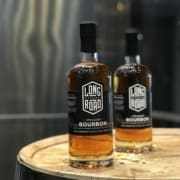
As we prepare for the release of Long Road Straight Bourbon Whisky, on Tuesday, April 10, we thought it might be helpful to clear up some of these misconceptions with a series of four blog posts, pulling apart the definition piece by piece, and offering explanations for the where, what, how, and why of Bourbon.

Today, we start with the “where”: “Whisky produced in the U.S….”

One of the most common myths about bourbon is that it has to be made in the state of Kentucky. There are many reasons why people may have heard or think this, not least of which is the fact that the term “bourbon” became associated with whisky in Kentucky as early as the 1820’s and consistently used to describe whisky made and distributed from Kentucky by the 1870’s. There is some debate on the inspiration of the term, though. Some suggesting it had to do with the county, Bourbon County, in Kentucky where bourbon whisky was allegedly first made (this is heavily disputed, and it seems to us, based on research, that it probably was NOT first made in Bourbon County). Others argue that the term “bourbon” was more likely inspired by Bourbon Street in New Orleans. Whisky was one of the largest exports (and still is) from the State of Kentucky, and many barrels were marked “Bourbon Street” and sent down the Ohio River to Louisiana. Over time, people began asking for it in New Orleans as simply “Bourbon”.

The other reason many folks assume Bourbon must come from Kentucky is the sheer volume that comes from the State. As of 2014, the Kentucky Distillers’ Association reported over 5.5 million barrels of bourbon aging in Kentucky – outnumbering the people in the state by over 1 million! And, in terms of global production, Kentucky makes 85% of the world’s bourbon.

Some distilled spirits, by legal definition and international treaties, have geographically protected names. Scotch must be made in Scotland; Tequila must come from certain regions of Mexico; Irish Whisky has to be manufactured in Ireland. Bourbon doesn’t have such protection.

The legal definition of Bourbon Whisky from the TTB mandates that it must be made in the United States – anywhere in the United States.

As the number of distilleries in the U.S. rises, so too does the number of bourbons being produced outside the State of Kentucky.

At Long Road, we’re proud to offer the first Bourbon ever milled, mashed, fermented, distilled, aged and bottled 100% in Grand Rapids, Michigan. We’re excited to add our whisky to the rich heritage of distilleries and distillers that have come before us. And, we can’t wait for you to taste what we’ve been working on! Take the Long Road!

Stay tuned for Parts 2-4 of “What is Bourbon?” coming over the next several weeks!

Join us Tuesday, April 10 between 4 pm and midnight for the release of Long Road Straight Bourbon!

Long Road Distillers

In Part 4 of our “What is Bourbon” series, dig into the final requirement for a spirit to be considered bourbon – the aging process – and how that can impact not only how a bourbon tastes, but also how it is labeled.

First, as a bit of a refresher, recall that the legal definition of bourbon whisky, according to the TTB, is:

Whisky produced in the U.S. at not exceeding 80% alcohol by volume (160 proof) from a fermented mash of not less than 51 percent corn and stored at not more than 62.5% alcohol by volume (125 proof) in charred new oak containers.


For those new to whisk(e)y or unfamiliar with the process, it’s often a surprise that it all comes off the still clear. It’s only through the aging proc