Long Road Distillers

For Part 1 of the “What is Bourbon” series, click here.

Today, we wade into a lesser-known part of the definition of Bourbon, which also means it’s a bit less controversial.

First, as a bit of a refresher, recall that the legal definition of bourbon whisky, according to the TTB, is:

Whisky produced in the U.S. at not exceeding 80% alcohol by volume (160 proof) from a fermented mash of not less than 51 percent corn and stored at not more than 62.5% alcohol by volume (125 proof) in charred new oak containers.


The phrase “Alcohol by Volume” (ABV), when associated with a percentage, is quite literally what it sounds like: the measure of the content of ethanol (alcohol) in an alcoholic beverage by volume. It is required by the Code of Federal Regulations for distilled spirits labels to include the ABV on the front of the bottle.

The term “proof”, while not required on spirits labels, is often included, particularly when it comes to whisk(e)y. The history of the term dates back to the 16th century and involves gun powder, taxes, and rum – a fun history indeed, but something for another blog post! The easiest way to understand proof in the United States is simply twice the ABV of an alcoholic beverage. So, a 100 proof whisky has an ABV of 50%.

This part of the definition has to do with the ABV/proof of the spirit as it comes off the still. Distillers are able to change the conditions in the still to control the ABV/proof during distillation, including the amount of heat applied to the mash, the amount of plates the alcohol vapor comes in contact with, or the amount of cooling water in the condensers that will cause reflux and re-distillation, just to name a few. The mandate here is to keep the spirit coming off of the still at or below 80% alcohol or 160 proof.

The question one could ask is: why limit this?

The answer: Taste and aroma.

The process of distillation is really a process of volume loss. To offer a rough example, we take 500 gallons of 6% mash/wash, distill it up to 45% ABV and between the heads cut, tails cut, and what’s left behind in the still, we lose most of our volume, yielding approximately 80 gallons of spirit. We’ll then distill that a second time to a higher ABV and lose even more volume. Essentially, we’re pulling the alcohol out into higher and higher concentrations, leaving behind water, grain, and yeast.

In this process, we’re not only leaving behind water, but flavor compounds, congeners, and impurities.

By definition, vodka must be distilled up to or exceeding 190 proof or 95% alcohol. The process of distilling something to 190 proof will theoretically leave it “odorless and tasteless”. The alcohol was concentrated and water and compounds were left out.

So, by requiring Bourbon to be distilled at or below 80% alcohol or 160 proof, more flavor is maintained. Now, we can’t say that maintaining flavor is the reason the Federal Government mandated this limit, but what they were trying to do was create a recognizable, familiar type and class so consumers could understand what they’re getting in a bottle. By mandating a maximum proof at distillation, the hope is that bourbon whisky produced in this manner with then have the “taste, aroma and characteristics generally attributed to” this type of whisky.

If you want to experience this phenomenon in person, stop in to the distillery and taste the difference between our unaged Corn Whisky, distilled to only 152 proof, and our vodka, distilled to 191 proof. While the mash bills (recipes) are different, you’ll still begin to understand the difference “proof at distillation” has on a spirit. The Corn Whisky has loads of flavor, even a bit of bite, while the Vodka flavors are much more soft and subtle.

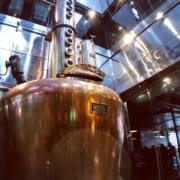
At Long Road, our experienced team of distillers takes great care in crafting a unique product with robust flavors in a consistent manner. We’re proud of the fact that we worked with Vendome Copper and Brass, arguably the best whisk(e)y still manufacturers in the world (not many people will argue this fact), to create a custom 500 gallon copper pot still that allows us to handcraft our bourbon both precision and a touch of artistry. And, we’re eager for you to taste the difference when you Take the Long Road!

Stay tuned for Parts 3 & 4 of “What is Bourbon?” coming over the next few days!

Join us Tuesday, November 8 between 4 pm and midnight for the release of Long Road Bourbon!
Straight Bourbon Long Road Distillers

If you ask 10 whisk(e)y drinkers to define bourbon, you’re likely to get 10 different answers. That seems to be due to a variety of myths, misconceptions, and misunderstandings surrounding one of America’s favorite whiskies.

According to the Alcohol and Tobacco Tax and Trade Bureau (or the TTB), the branch of the U.S. Department of the Treasury that regulates and oversees the distillation, sale, and taxation of distilled spirits, Bourbon Whisky is:

Whisky produced in the U.S. at not exceeding 80% alcohol by volume (160 proof) from a fermented mash of not less than 51 percent corn and stored at not more than 62.5% alcohol by volume (125 proof) in charred new oak containers.


As we prepare for the release of our first Bourbon Whisky on Tuesday, November 8, we thought it might be helpful to clear up some of these misconceptions with a series of four blog posts, pulling apart the definition piece by piece, and offering explanations for the where, what, how, and why of Bourbon.

Today, we start with the “where”: “Whisky produced in the U.S….”

One of the most common myths about bourbon is that it has to be made in the state of Kentucky. There are many reasons why people may have heard or think this, not least of which is the fact that the term “bourbon” became associated with whisky in Kentucky as early as the 1820’s and consistently used to describe whisky made and distributed from Kentucky by the 1870’s. There is some debate on the inspiration of the term, though. Some suggesting it had to do with the county, Bourbon County, in Kentucky where bourbon whisky was allegedly first made (this is heavily disputed, and it seems to us, based on research, that it probably was NOT first made in Bourbon County). Others argue that the term “bourbon” was more likely inspired by Bourbon Street in New Orleans. Whisky was one of the largest exports (and still is) from the State of Kentucky, and many barrels were marked “Bourbon Street” and sent down the Ohio River to Louisiana. Over time, people began asking for it in New Orleans as simply “Bourbon”.

The other reason many folks assume Bourbon must come from Kentucky is the sheer volume that comes from the State. As of 2014, the Kentucky Distillers’ Association reported over 5.5 million barrels of bourbon aging in Kentucky – outnumbering the people in the state by over 1 million! And, in terms of global production, Kentucky makes 85% of the world’s bourbon.

Some distilled spirits, by legal definition and international treaties, have geographically protected names. Scotch must be made in Scotland; Tequila must come from certain regions of Mexico; Irish Whisky has to be manufactured in Ireland. Bourbon doesn’t have such protection.

The legal definition of Bourbon Whisky from the TTB mandates that it must be made in the United States – anywhere in the United States.

As the number of distilleries in the U.S. rises, so too does the number of bourbons being produced outside the State of Kentucky.

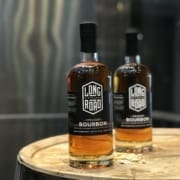
At Long Road, we’re proud to offer the first Bourbon ever milled, mashed, fermented, distilled, aged and bottled 100% in Grand Rapids, Michigan. We’re excited to add our whisky to the rich heritage of distilleries and distillers that have come before us. And, we can’t wait for you to taste what we’ve been working on! Take the Long Road!

Stay tuned for Parts 2-4 of “What is Bourbon?” coming over the next several days!

Join us Tuesday, November 8 between 4 pm and midnight for the release of Long Road Bourbon!
Wendy Peppercorn Long Road Distillers

International Flavored Vodka Tasting Event Awards Grand Rapids Distillery with Double Gold

Long Road’s Wendy Peppercorn Vodka stands out from a crowded field of flavored spirits.

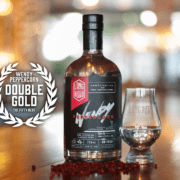
Grand Rapids, Michigan – Internationally recognized Grand Rapids distillery, Long Road Distillers, announced more top honors for their line-up of spirits, this time coming from a competition in New York City. The distillery was awarded a Double Gold medal for Long Road Wendy Peppercorn at The Fifty Best Flavored Vodka tasting event.

The award-winning-101-proof spirit is made from 100 percent locally grown red winter wheat, milled, mashed, fermented and distilled on-site at the Westside distillery,  then redistilled with pink peppercorns, the berry from the Peruvian Peppertree. Non-chill filtration techniques give all of Long Road spirits a smooth, handcrafted taste rather than the overly processed, astringent flavors that result from the carbon and charcoal filtration technique used by many. Wendy Peppercorn is  a whopping 101 proof, or 50.5  percent alcohol by volume (ABV), a full 10.5% higher than any of the other entries in the Fifty Best competition.

“As far as we know, Wendy Peppercorn is the only pink peppercorn flavored vodka in the world,” said Co-Owner Kyle VanStrien. “Pink peppercorn happens to be one of the botanicals in our gin, and since we’re distilling each gin botanical individually, we discovered that we loved pink peppercorn all by itself!”

“We’re products of the 80’s,” said Co-Owner Jon O’Connor in reference to the name Wendy Peppercorn. “Most of us on the Long Road team grew up watching the movie The Sandlot. We all remember the scene where Michael “Squints” Palledorous expressed his passion for Wendy Peffercorn, the lifeguard at the community pool, and we feel the same way about this vodka! This is our nod to a classic movie for our generation, and a fun way for us to play up the high proof of this spirit. Wendy 101 has a great ring to it, but we’ve also left the spirit at 101 proof to amplify the flavors and keep the essential oils that carry over in the distillation process suspended.” Similar to an absinthe or ouzo, Wendy Peppercorn will cloud up with the addition of water, altering the aromas, texture, and flavor to make the spirit more floral and fruity.

Spirits from around the world were entered into the Fifty Best event. 17 pre-qualified judges evaluated each spirit separately based on preset tasting rules. Each spirit was served to judges in fresh glasses from newly sealed bottles and was served slightly above room temperature to ensure optimum flavor. Judges noted their nose, palate and finish impressions of Long Road Wendy Peppercorn, which provided, “attractive spice notes, a wonderful mouthfeel, and a surprisingly sweet, soft and subtle finish.” The judges added that it would be, “perfect for a Bloody Mary!”

Long Road Distillers has garnered a multitude of international honors for their line of spirits. The most notable accolades were earned at the world’s largest spirits competitions and include several “Best in Show” awards, nearly a dozen double-gold medals, and numerous gold, silver and bronze medals. The West Michigan Distillery has also expanded distribution to over 400 Michigan grocers, specialty retailers, and bars and restaurants in the past year.

“This has been a huge year of progress for Long Road,” said O’Connor. “Every award won and distribution expansion made motivates our team to stay committed to our mission and values. We look forward to what the future has in store for our distillery.”

Book A Tour